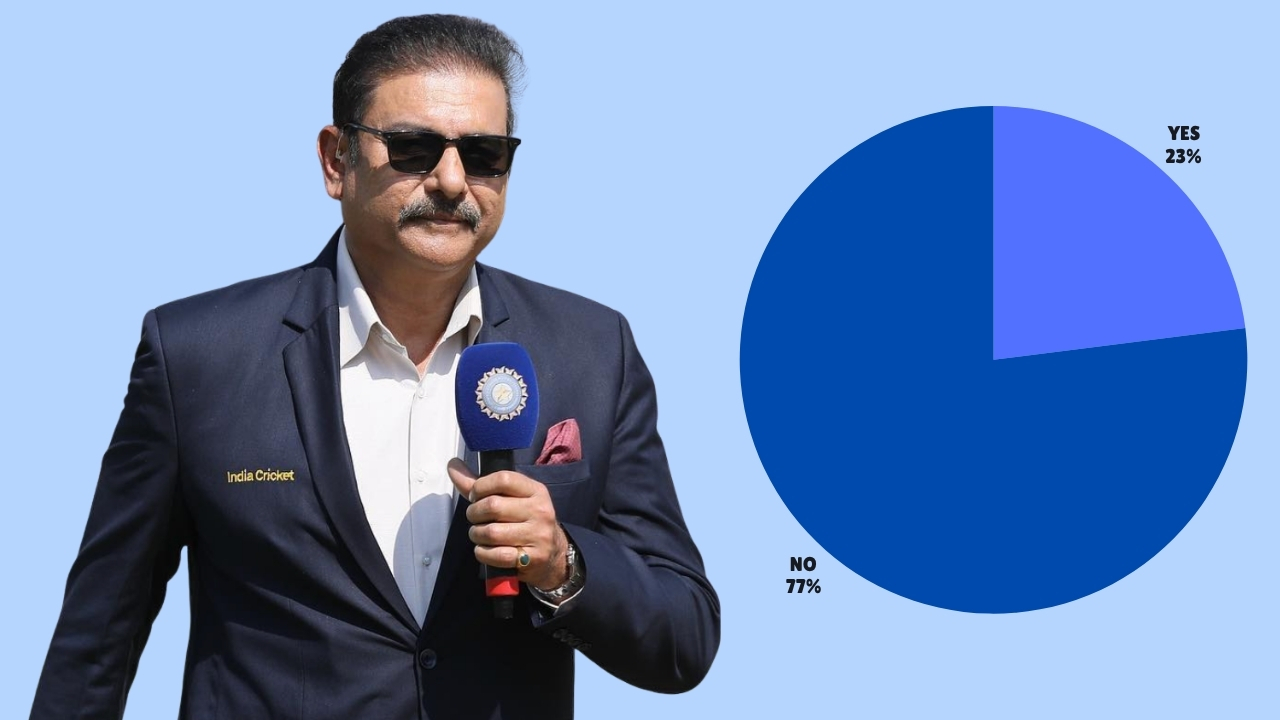
In global cricket, few issues are as divisive—or as consequential—as how money is distributed. This week, cricexec ran a poll of senior global cricket executives asking a simple, pointed question:
Do you agree with Ravi Shastri that India deserves more than its current 38.5% ICC revenue share?
The results were resounding:
No – 77%
Yes – 23%
The numbers tell a clear story: while many respect India’s immense commercial power, the majority of stakeholders remain uncomfortable with the idea of increasing India’s already commanding share of ICC revenue.
Yet behind those numbers lies a deeper, more complex debate—one that has shaped the future of the global game and crystallized tensions between commercial reality and sporting equity.
Shastri: “India deserves more”
The poll was prompted by a recent Cricexec article based on comments by Ravi Shastri, the former India head coach, who argued forcefully that India’s 38.5% share is not only fair—but possibly too small.
“I would want more [for India]. Because half the money – most of the money – that’s generated comes from India,” Shastri said on Wisden Cricket Weekly. “So it’s only fair that they get their share of… pound of flesh. And it’s relative, you know, it’s economies.”
He pointed to India’s massive impact on broadcast deals and commercial markets:
“When India travel, look at the television rights, look at the television income that comes for an India series. So it’s only fair that they get whatever they’re getting now, if not more.”
ECB backs India’s share—at least publicly
While 77% of Cricexec’s poll respondents said no to an increase, several top figures in the England and Wales Cricket Board (ECB) have gone on record in support of India’s financial position.
“India generate the bulk of the game’s wealth and they would be entitled to take more revenue than they do,” said ECB Chair Richard Thompson in The Athletic. “They take probably 10 per cent less than they justifiably could.”
ECB CEO Richard Gould went even further on The Final Word podcast:
“They make probably 90% of the value and therefore BCCI and India should have a significant say in what happens. And I’ll go further… If you look outside of the other members of the ICC, if you take out the ICC revenues that are generated, largely by India, not more than four or five or perhaps six boards are actually financially sustainable based on their own domestic cricket markets..”
“We all rely hugely on the Indian market.”
But even these defenses come with a recognition that power must be handled carefully. Gould noted, for example:
“I would also argue that the BCCI take their responsibilities on the global cricket market really seriously.”
Power, politics, and the price of domination
Several industry insiders and pundits have expressed concern that India’s dominance—while financially justified—can distort the fairness of global events.
Mihir Bose, author of The Nine Waves: The Extraordinary Story of How India Took Over World Cricket, was blunt in his assessment:
“I don’t think India are using their power wisely,” Bose told The Athletic. “They’re behaving worse than the colonial powers… What are you going to do about it?”
Bose pointed to the 2025 Champions Trophy controversy, where India refused to play any matches in Pakistan and was allowed to play all their games in Dubai:
“Imagine that happening in football. There’s a World Cup in England, but Germany say: ‘We’re not playing there, we’re going to play all our games in France’. FIFA would say: ‘Sorry, mate, this is not on’. But India got away with it.”
Gavaskar, Bhogle, and the defense of India’s role
Indian legends like Sunil Gavaskar and Harsha Bhogle have pushed back on this narrative—defending India’s position and calling for a more realistic view of economic influence.
“They just cannot seem to understand where India stand in international cricket,” Gavaskar wrote in Sportstar. “They need to understand that their salaries also come from what India brings to the world of cricket.”
Bhogle added in The Athletic:
“India more than play their part in the health of the world game… I remember Ramiz Raja (the former Pakistan captain) making a speech in Pakistan saying: ‘I know this is hard to hear, but we are living off Indian corporate income’.”
“That is the reality of our times and it shows no signs of stopping.”
A question of structure, not sentiment
In many ways, the revenue debate is a proxy war between two competing visions for cricket:
- One rooted in commercial realism, where power follows money.
- One rooted in global development, where ICC revenues help smaller nations grow and compete.
Ravi Shastri is clear which side he’s on.
“Why are cricket boards losing money hand over fist?” he asked. “Is the administration okay? Are they being handled properly? Is the game being run properly? And is there accountability? For me, that is the key.”
Final verdict: Reality vs. resistance
Cricexec’s poll shows that a global majority of cricket executives believe India’s share should not increase—a pushback against voices like Shastri, even as they acknowledge India’s immense contribution.
But in a sport where one market generates 80–90% of global value, the lines between fairness and financial survival continue to blur.
As Mihir Bose put it:
“India is dictating to the world. They are saying: ‘We’ve got the money. If you want it, it has to be on our terms.’”
And yet, as Richard Thompson concluded:
“They’re not bullies. They understand the game’s needs.”
In this delicate balance of power, perception, and partnership, the global game faces a defining question:
Can cricket remain a world sport—when one nation writes the checks?