

Vishal Misra is Vice Dean for Computing and AI and Professor of Computer Science at Columbia University. He was a co-founder of CricInfo and was its founding CTO. He is part of the San Francisco Unicorns’ ownership group and also helps run the team’s analytics operations. This post is written in his personal capacity.
I recently had the privilege of attending World Cricket Connects 2025 at Lord’s Cricket Ground — a remarkable gathering of administrators, players, broadcasters, and thinkers engaged in some of the most candid and constructive discussions I’ve heard about the future of the game. Extremely grateful to Mark Nicholas for inviting me to attend. I was certainly an outsider — a professor by trade — but the organizers couldn’t have been more welcoming. In fact, I even made it into a photo collage posted by @HomeOfCricket alongside Gideon Haigh, Mike Atherton, and Kumar Sangakkara. As I joked in a LinkedIn post, I was pleased to offer Kumar some reflected glory.
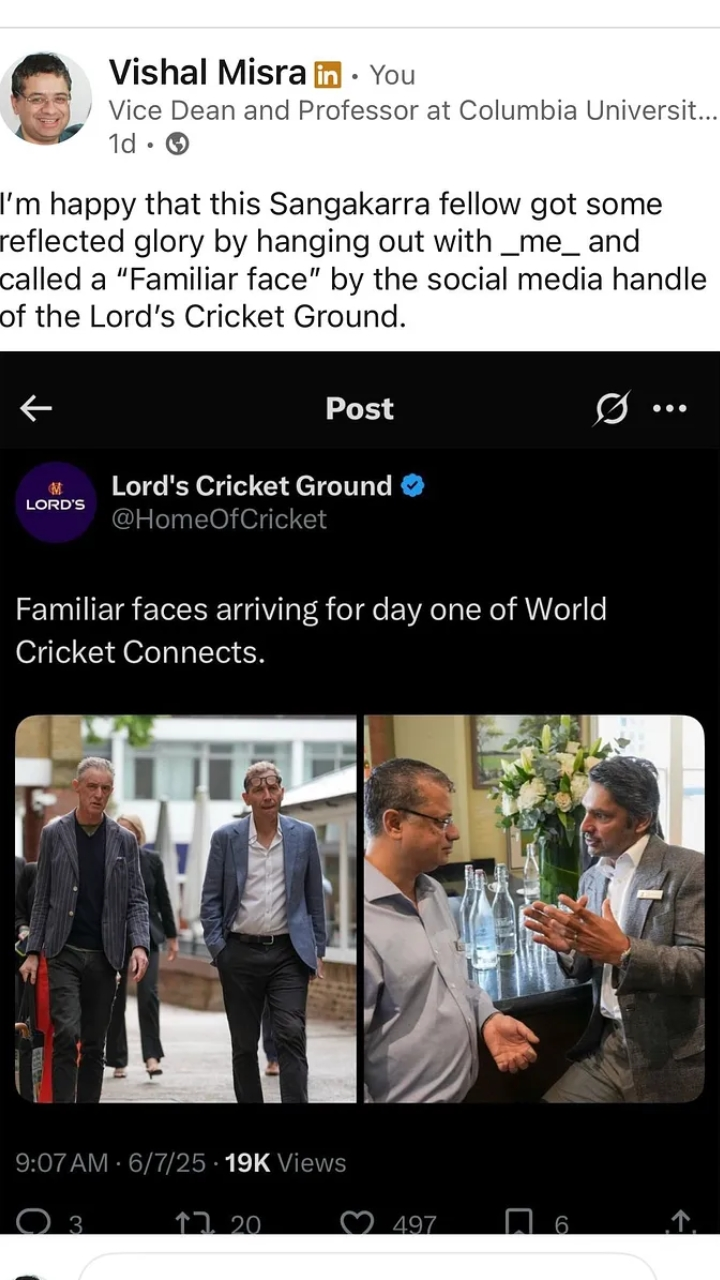
But joking aside, one of the privileges of being an outsider is being able to ask the uncomfortable questions.
A Flutter in the Long Room
During one of the sessions, I posed what I thought was a straightforward question about India’s absence from global cricket reform efforts. I followed up directly in the room (as seen in the photo below), and the question clearly struck a chord. Several attendees, including some prominent current and former players, came up to thank me afterwards for voicing what many were thinking.
Bridging the Divide
The responses to my question were equally illuminating. Former BCCI representatives present made compelling points about India’s existing contributions to global cricket — from extensive touring schedules that generate crucial broadcast revenue for host nations to substantial investments in domestic player development from grassroots levels. These are genuine and significant contributions that deserve recognition.
The challenge, however, lies in translating these existing strengths into collaborative frameworks for the sport’s future. India’s deep investment in player development, for instance, could be leveraged not just for domestic success but as a model for global talent exchange programs. The touring commitments that already drive revenue could be structured within the proposed global windows to benefit everyone.
What struck me wasn’t disagreement about cricket’s challenges, but rather different perspectives on how to address them. The reform discussions at WCC and India’s current approach aren’t necessarily incompatible — they simply haven’t been aligned in a shared conversation.
The essence of the question was this:
How do we solve the “India” problem? India is not in the room, not part of the World Cricketers’ Association, doesn’t play in any international franchise leagues, and yet commands almost all the revenue. How do we get them to collaborate more?

The point wasn’t to assign blame. Quite the opposite. It was to highlight that India’s centrality to cricket’s economic structure makes it an essential participant in any attempt at reform.
Where the Power Is — and Isn’t
Many of the discussions at WCC were thoughtful, pragmatic, and genuinely future-focused. The World Cricketers’ Association presented a compelling report outlining how to carve out distinct global windows for Test cricket and franchise leagues. Others proposed expanding ICC membership to include player unions, broadcasters, and franchise owners to depoliticize the current boardroom setup. There was even talk of tiered Test cricket structures and bilateral scheduling models based on market maturity.
All excellent ideas. But they floated in a vacuum — because the most powerful entity in cricket governance wasn’t there. India isn’t part of the WCA. It has no representation in any of the international franchise leagues. And it does not allow even its emerging players to participate in overseas leagues like Major League Cricket.
The Missed Opportunity of MLC
This last point is especially frustrating. Major League Cricket in the U.S. has built an impressive early foundation. It draws a strong Indian diaspora audience — a ready-made fanbase. Imagine what would happen if India allowed just a few players from its deep talent pool — not stars like Kohli, but rising or emerging names like, say, a Vaibhav Suryavanshi — to play in the MLC. The crowds would come. The league would improve. Young Indian players would get international exposure.
It would be a win-win. But the BCCI doesn’t allow it. Not out of malice, necessarily, but out of a need to maintain centralized control.
Who Gets to Shape the Future?
All of this leads to the uncomfortable truth: cricket’s future is being earnestly debated in rooms like the Long Room — but the center of gravity lies elsewhere. The economic weight of India means that no serious structural reform can happen without its buy-in. And yet, for now, India remains disengaged from these multilateral efforts.
Until that changes, we risk staging well-intentioned but ultimately ineffectual conversations.
Progress in the Women’s Game
There was one particularly striking session on the future of the women’s game, led by Mel Jones, where the need for better equipment design — specifically, a ball engineered for the women’s game — was laid out with clarity. I found it to be a model of what meaningful progress can look like when the right voices are present.
But even there, I couldn’t shake the irony: the energy, ideas, and goodwill were abundant throughout WCC. But unless we find a way to bring the BCCI — the elephant not in the room — into these conversations, we may be designing blueprints for a house no one can build.

The Path Forward
The energy and expertise at World Cricket Connects 2025 demonstrated that cricket has no shortage of innovative thinkers or practical solutions. The framework for meaningful reform exists. What’s needed now is expanding this very forum to bring together all stakeholders — including the BCCI — in a spirit of mutual respect and shared purpose. World Cricket Connects 2026 could be the venue where these parallel conversations finally intersect, creating a truly comprehensive dialogue about cricket’s global future.
Cricket doesn’t just need vision. It needs participation. And right now, the most influential stakeholder in the sport is politely declining the invitation.


